Google Nest · UX Design · 2024
A shared thermostat for offices because one person's comfort shouldn't come at everyone else's expense.
Role
UX Designer
Team
Brayden, Julian, Joy, Chris, Ting, Mariana
Duration
10 Weeks
Year
2024
A smarter way to manage comfort in a shared office.
Google Nest was designed for homes. This project adapted it for a fundamentally different context: the shared office, where multiple people with different thermal preferences have to coexist under one thermostat. We redesigned both the physical device and companion app to support collective comfort rather than individual control.
My Role
I led the companion app interaction design from low-fidelity wireframes through to the final prototype. I also contributed to the physical device interface and co-led user testing across both platforms.
One thermostat. Twelve opinions. No process.
In a shared office, the thermostat is almost always controlled by whoever noticed the temperature first or sits closest to the dial. Everyone else adapts by adding a layer, opening a window, or silently resenting the person who turned it to 78°F. There is no input channel, no way to signal a preference, and no mechanism for the system to know it is serving a room of people rather than a single user.
The core tension: temperature is a shared experience managed through individual action. Someone always wins. Someone always loses. We needed a system where nobody has to fight for it.
Six participants. Three methods. One clear pattern.
We recruited students and SCAD faculty who used only traditional analog thermostats with no smart home experience. This shaped everything. The redesign had to earn trust before asking for behavior change.
Interviews
Pre and post-session interviews covering thermostat habits, smart device familiarity, and preferred workspace temperatures
Observation
Structured task scenarios on both the physical device and the companion app, recorded for error analysis
SUS Questionnaire
System Usability Scale administered after each test session to generate comparable quantitative scores
Key Finding
Users did not want more control over the thermostat. They wanted the process of changing it to feel fair to everyone in the room
Designing fairness, not just controls.
The central design question was: how do you give twelve people a voice in a single output? Early sketches explored voting systems, averaging models, and weighted preferences. We narrowed to a comfort zone model where each user sets a range and the system finds the overlap.

Every device task completed. Every time.
We ran five structured tasks on the physical device and five on the companion app. The device achieved 100% completion on all tasks. The app hit 80% on initial login and temperature setup.
Log in and set preferred temperature
Device
100%
App
80%
Navigate to Wednesday in the schedule
Device
100%
App
100%
Set a temperature request for 8:00 AM
Device
100%
App
100%
Post-session feedback highlighted two friction points: the initial slider for setting temperature preferences was unclear, and the navigation menu needed more visual hierarchy. Despite these issues, most participants said they would use the system in their actual office.
Three screens. One comfortable office.
The final experience is built around three core interactions. Click each screen to see what it does and why.
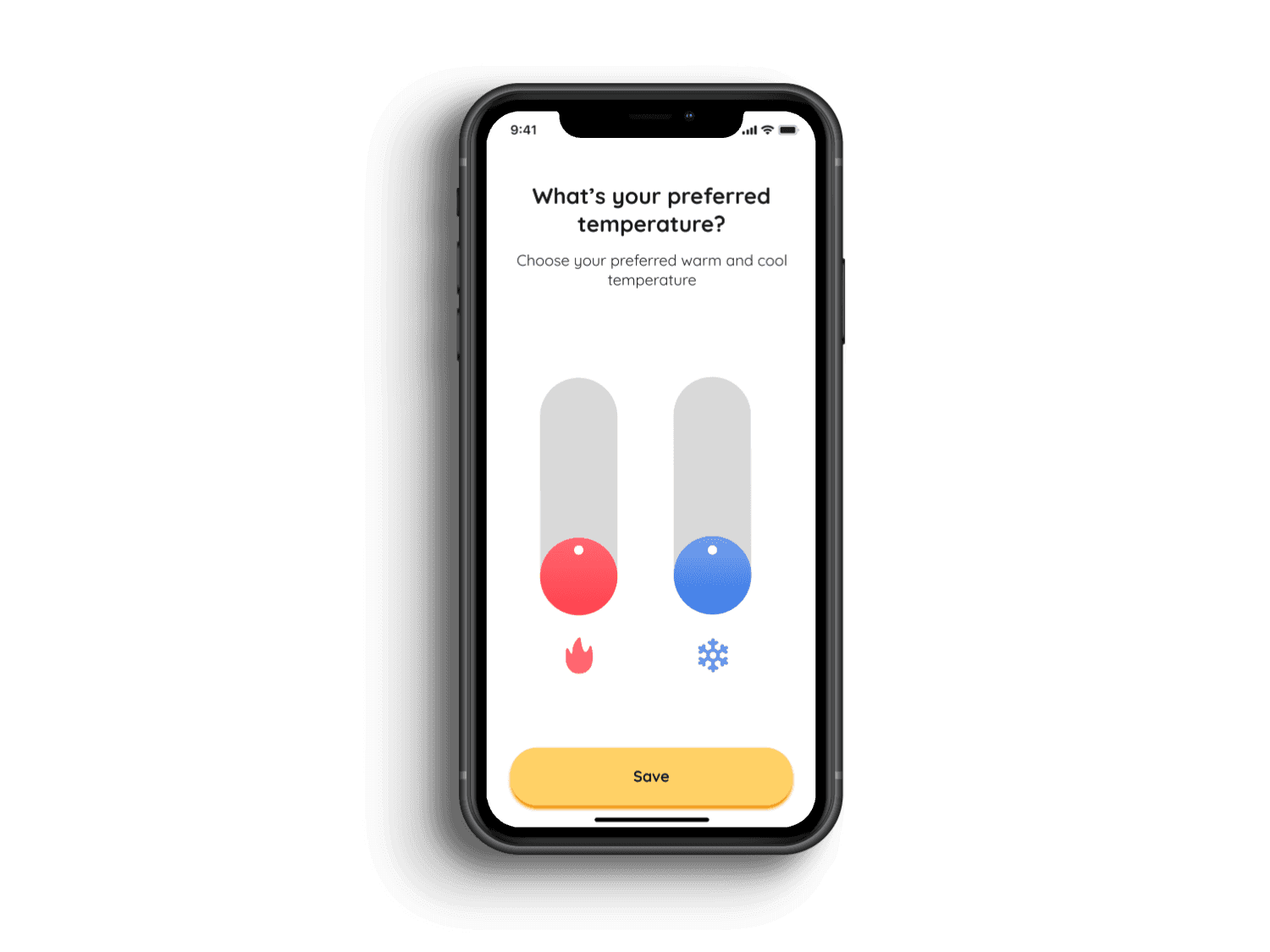
Comfort Zones
Each user sets a personal temperature range rather than a fixed number. The system finds the overlap and maintains a temperature within that shared zone.
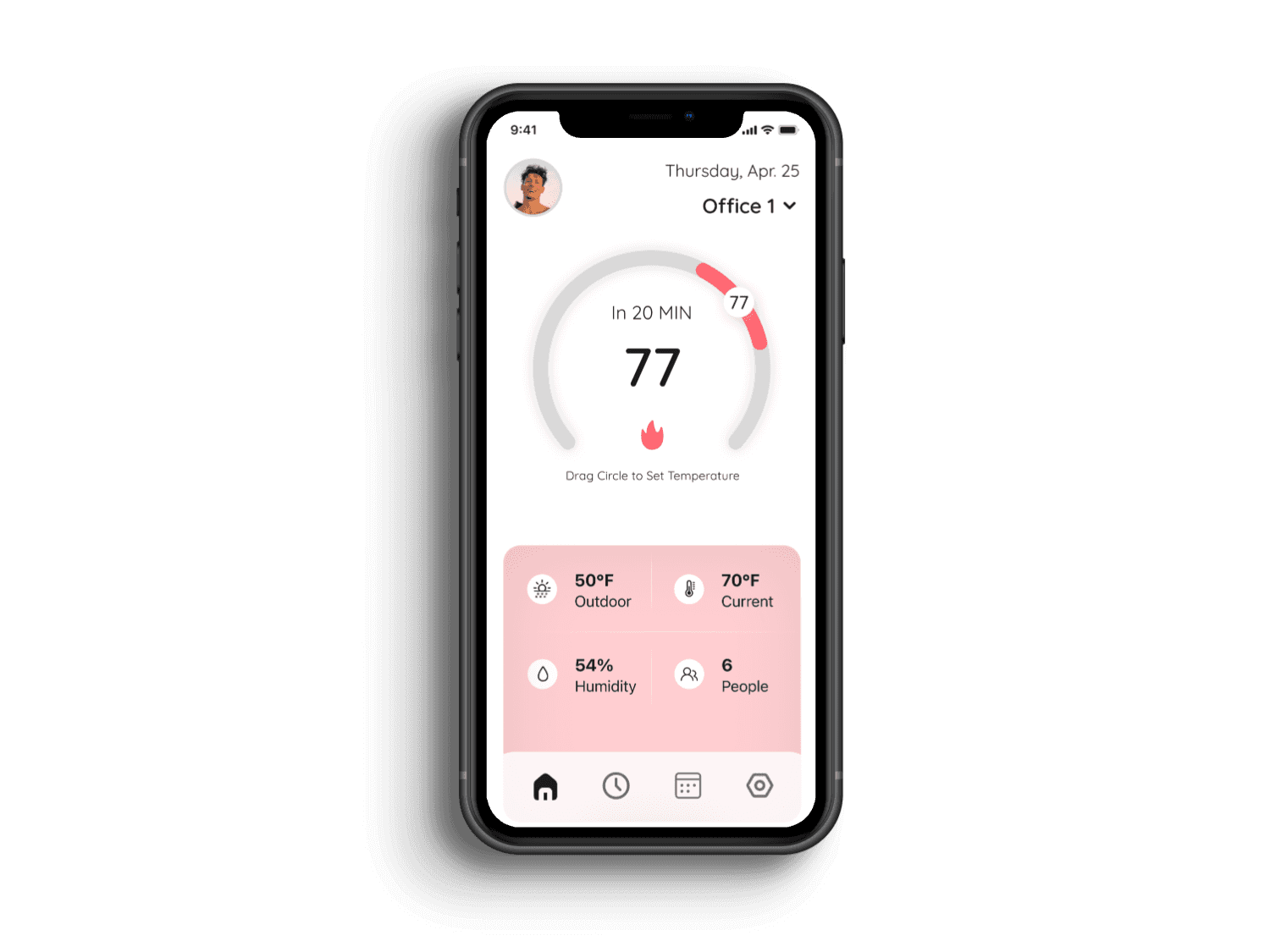
Temperature Controls
Real-time adjustments are scoped to the user's own preference range, not the thermostat directly. This prevents individual overrides while still giving people agency.
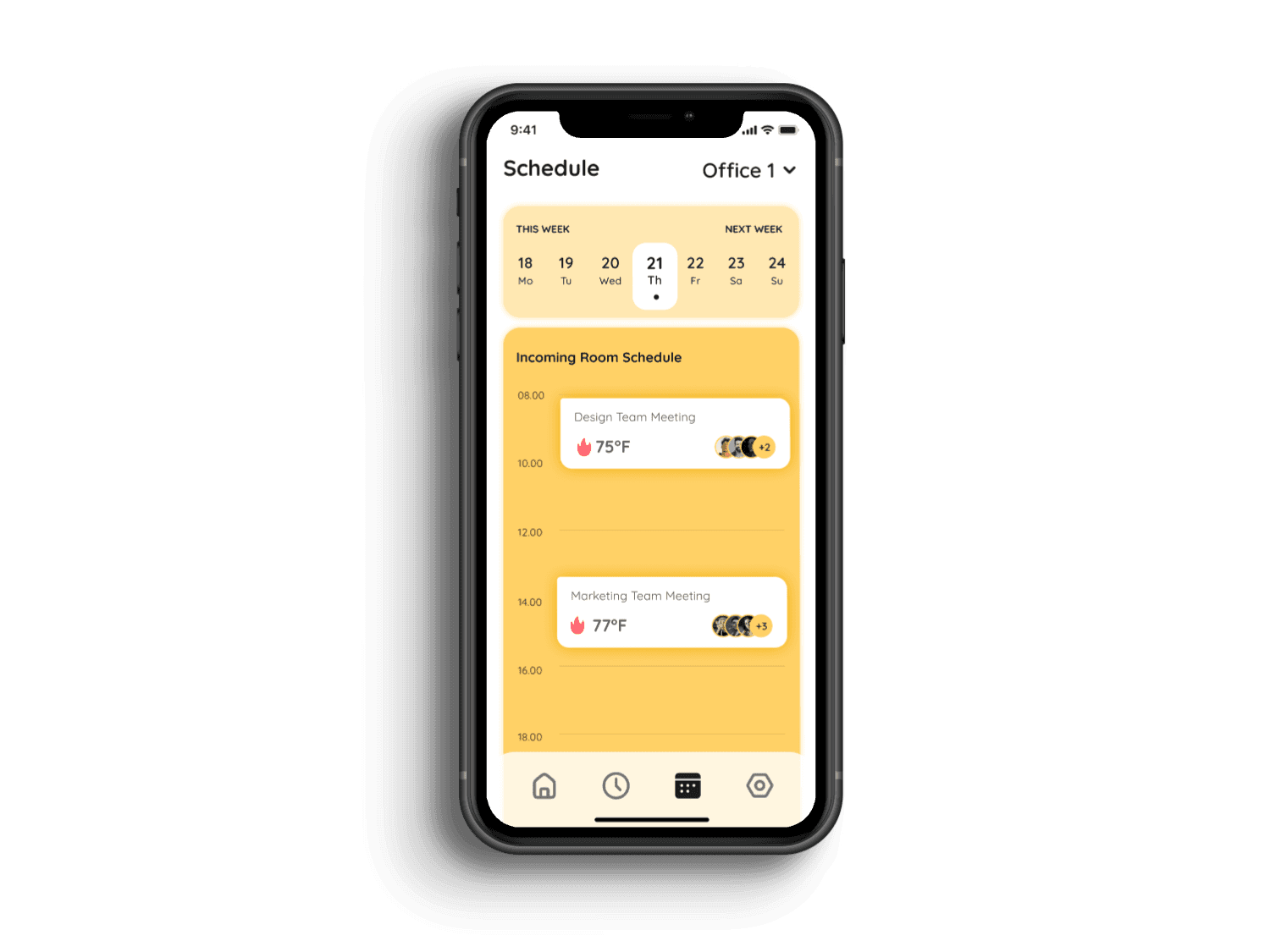
Schedule Overview
The schedule shows who is in each space and when, so temperature changes are contextual rather than arbitrary.
The case for investing in workplace comfort.
This is not a soft benefit. Decades of research show that office temperature directly affects output, error rates, and labor cost.
10%
Increase in hourly labor costs when workers are too cold. Cornell University, 2004
44%
Fewer errors made when offices maintained a comfortable temperature. Cornell University, 2004
Reduced workplace friction
Tap to flip →Why it matters
Temperature conflict is a daily, invisible tax on focus. A system that resolves it automatically gives teams back the attention they were spending on a problem that should not require their involvement.
Stronger team culture
Tap to flip →Why it matters
When people feel heard, even by a thermostat, trust compounds. Collective fairness in small moments signals the kind of culture that retains people.
Ready to scale
Tap to flip →Why it matters
The system is designed for multi-room, multi-team environments. As a business grows, comfort scales with it. No manual reconfiguration, no new friction.
Smarter energy usage
Tap to flip →Why it matters
Scheduled zones and shared preferences mean the system only heats and cools when and where it needs to, cutting waste without asking anyone to change their behavior.
Comfort without conflict.
Before this system, someone in every office decides the temperature and everyone else adapts. The friction is real, recurring, and entirely avoidable.
After: preferences are submitted individually, resolved automatically, and displayed transparently. The negotiation is gone. People get back to work.
The design principle
Comfort should not require conflict. Good design removes the negotiation entirely and replaces it with a process that feels fair without anyone having to ask for it to be.
More work
Google Nest
Shared thermostat for offices
You are here
Let's talk